Helping Industry to become Energy Independent and Reduce carbon footprint.
Owning your own solar system will benefit your production cost due to the rising price of electricity. Our focus at SHKYMCK Green Energy is to empower and enable organizations to contribute towards the decarbonization and decentralization of power. We understand India is a value-conscious market – the 30–50% savings in per-unit cost of power we offer customers continues to be our primary driver.
Reducing power costs for your organization, bringing down your carbon footprint, meeting Renewable Purchase Obligations, acquiring transient power from the spot market or transitioning to electric mobility – whatever your energy demand is, our organization will tailor-make the solar solution to suit your objectives.
Schedule a Industrial Feasibility Study
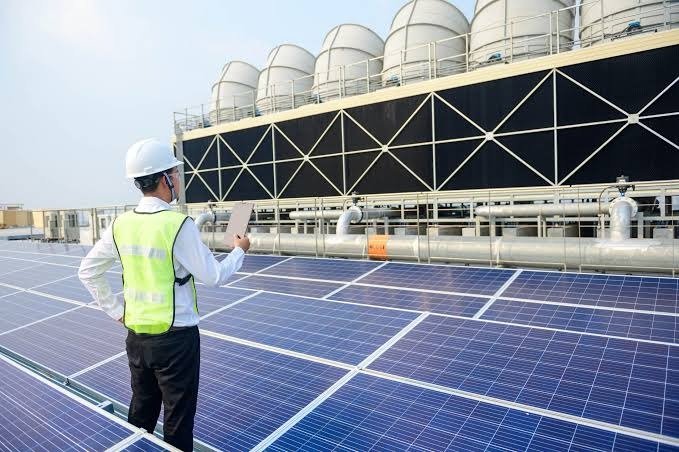
Commercial and industrial energy consumers have two primary pathways to leverage solar power depending on their land availability, energy demands, and scale of operations.
Designed for on-site rooftop systems (usually smaller capacity, capped limits) where excess generation offsets local consumption.
Allows large consumers (typically 1 MW and above) to buy electricity directly from third-party generators or remote solar/wind farms using the public transmission grid.
| Feature | Net Metering (On-Site) | Open Access (Off-Site) |
|---|---|---|
| Generation Setup | On-site (Rooftop / Carport / Ground) | Remote (Off-site solar/wind farms) |
| Eligible Consumer Scale | Any commercial/industrial size (typically < 1 MW) | Large consumers (typically > 1 MW connected load) |
| Capacity Limits | Capped by rooftop space and local transformer capacity | Uncapped / Multi-megawatt scalable based on total contract demand |
| Grid Wheeling Charges | Exempt (No wheeling charges) | Applicable (Incurs transmission & surcharges) |
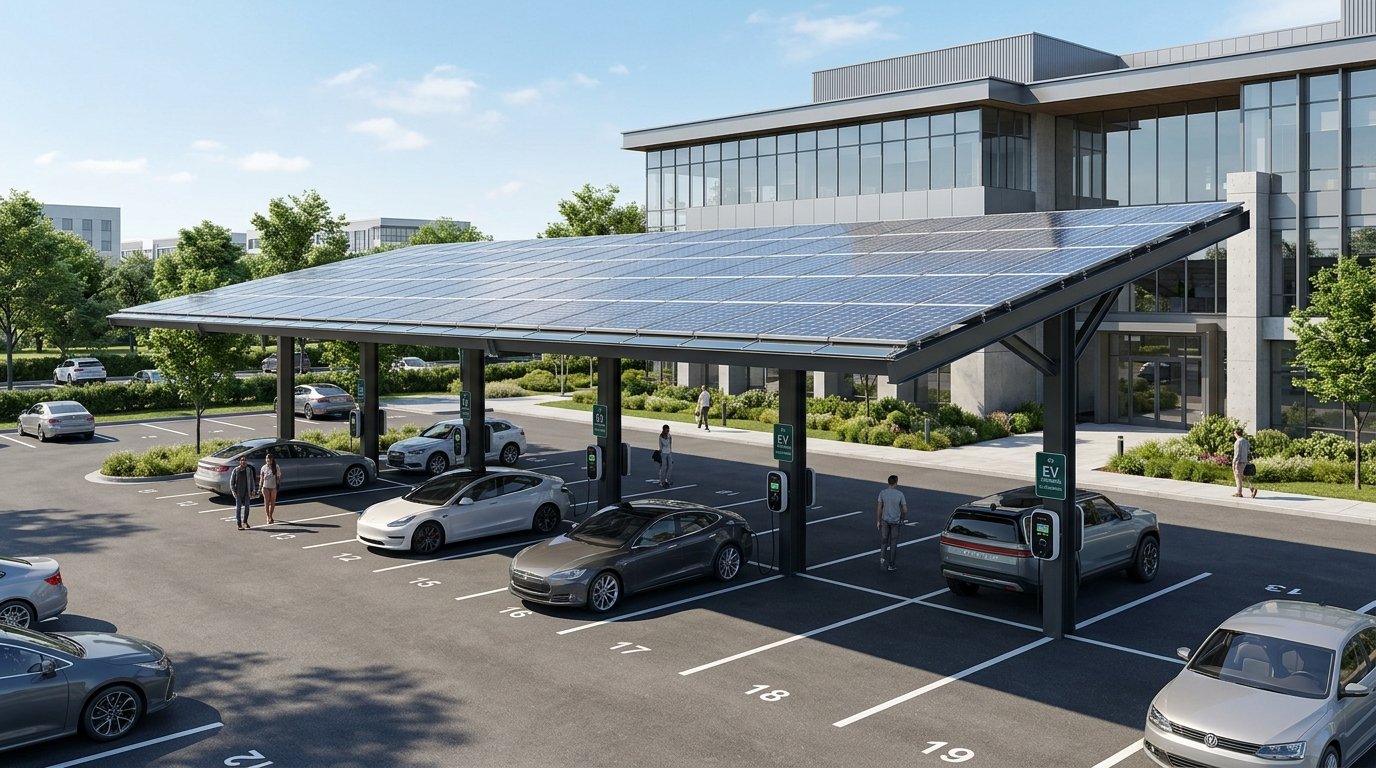
Maximize your parking lot's utility by converting open spaces into high-yield clean energy generators. Solar carports are the perfect solution for businesses with limited roof space or those looking to expand their renewable energy capacity.
Our structures are custom-engineered from premium, corrosion-resistant steel or anodized aluminum to withstand local wind loads. They provide shaded comfort to parked vehicles, reduce asphalt heat island effects, and can be seamlessly integrated with EV charging stations to support corporate fleet electrification.
Request a Carport Design Estimate
SHKYMCK Green Energy's ultimate guide highlights how underutilized parking areas become major financial and sustainability drivers. Here is how we deliver this technology:
Reduces carbon footprint and promotes sustainability.
Can support larger PV arrays than limited rooftop space.
Supports clean transportation with solar-powered charging stations.
Converts parking lots into energy-producing areas without using extra land.
Generates solar power to reduce electricity costs.
Ideal when rooftop installation is not feasible.
Ideal for single-row parking configurations. The cantilever architecture places structural supports on one side only, making it easy for drivers to maneuver in and out of spaces without column interference.
Perfect for large-scale parking lots with double rows of cars back-to-back. Uses a central T-Frame column or a four-column Pi-Frame design to support massive photovoltaic spans with minimal ground structural impact.
From initial assessment to grid integration and multi-decade maintenance, we follow a rigorous 9-step execution framework. Hover over each phase below to see its detailed description.
Detailed physical analysis of rooftop conditions, shading hazards, orientation, and structural integrity.
Evaluating electrical loads, energy demand curves, transformer capacities, and financial feasibility.
High-precision engineering of solar layouts, electrical string plans, civil mounts, and shadow simulations.
Submitting comprehensive commercial proposals, savings projections, and finalizing contract approvals.
Sourcing tier-1 modules, inverters, and structural components alongside precise project schedules.
Safe construction, mechanical mount assembly, module mounting, and electrical DC/AC cabling.
Comprehensive safety tests, string checks, insulation resistance testing, and trial system startup.
Liaisoning with utility inspectors, bidirectional net-meter testing, and official project handover.
Continuous cloud-based monitoring, periodic solar module cleaning, preventive checks, and upkeep.